Learn
3PL vs Amazon FBA: 2026 Costs, Peak Fees and When Each Wins
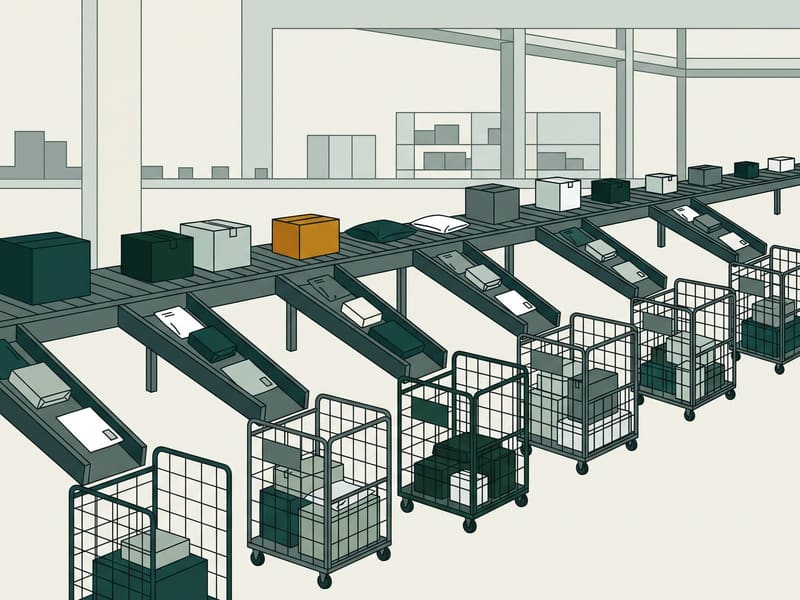
Amazon FBA keeps your stock in Amazon's buildings and ships your Amazon orders for one fee per unit, delivery included. A 3PL keeps it in its own warehouse and ships every channel you sell on, billing each task separately with postage on top. Below: what each costs on Amazon's 2026 rate tables, what changes from October 15, where each one wins, and how brands split stock between the two.
Quick summary
- FBA charges $5.42 to fulfill a 1.4 lb unit priced $10 to $50 until October 14, 2026 and $5.73 from October 15, plus a 3.5% fuel and logistics-related surcharge, and that fee includes delivery.
- At our example 3PL rates the same Amazon order costs $10.05 to $14.10 to ship merchant-fulfilled, because the postage alone runs higher than FBA's whole fee.
- FBA storage for standard-size stock costs $0.78 per cubic foot a month through September and $2.40 for October to December, so reserve stock is cheaper on a 3PL's pallet rate.
- FBA rates cover Amazon orders only, and Amazon's route for Shopify, TikTok Shop or Walmart orders is Multi-Channel Fulfillment at $10.64 for a single 1 to 2 lb unit before the surcharge.
- A 3PL fits wholesale and retail orders, branded packaging, slow sellers and reserve stock, while FBA fits fast-selling Amazon orders that need the Prime badge.
- A hybrid setup keeps Amazon demand in FBA and gives a 3PL the prep, the reserve and every other channel, and Amazon has not offered prep or labeling for US FBA inventory since January 1, 2026.
Amazon FBA and a 3PL side by side
Both do the same physical work: receiving, storing, picking, packing and shipping. The terms they do it on are very different.
| Amazon FBA | 3PL | |
|---|---|---|
| Who sets the terms | Amazon’s program policies, changed by Amazon | A contract you negotiate and sign |
| Orders it ships | Amazon orders; other channels through Multi-Channel Fulfillment at separate rates | Every connected channel, plus wholesale and retail orders |
| How the fee is built | 1 fee per unit by size tier, weight and price band, delivery included | A rate card: receiving, storage, pick and pack and materials each billed on its own, postage extra |
| Storage | Per cubic foot: $0.78 a month for standard-size through September, $2.40 for October to December | Per pallet, bin or shelf at contract rates |
| Prime badge | Eligible FBA offers carry it | Only through Seller Fulfilled Prime, after a 30-day trial |
| Packaging | Amazon’s packaging, or the product’s own box under Ships in Product Packaging; Multi-Channel Fulfillment ships unbranded by default | Your boxes, inserts and kits |
| Prep before inbound | Yours or a provider’s since January 1, 2026 | Can be part of the service |
| Customer service and returns | Amazon handles both on FBA orders | You answer customers; the 3PL processes returned parcels |
| How much stock you can hold | Capped by Amazon’s restock limits | The space in your contract |
What FBA does and what a 3PL does
Fulfillment by Amazon is a seller program. You send units into Amazon’s network, which Amazon says includes hundreds of fulfillment centers worldwide, and Amazon picks, packs and ships each Amazon order, then answers the customer’s questions and takes the return. Products in FBA are eligible for free 2-day shipping through Prime.
Amazon lets you assign some or all of your eligible products to FBA, listing by listing, so one seller account can run FBA and merchant fulfillment side by side, with each SKU in whichever route suits it.
A 3PL is an outside warehouse company you hire. It receives your inventory, stores it, and ships orders from every store, marketplace and wholesale account you connect to its system, under a contract with rates you can negotiate. On the warehouse floor FBA does the same work, which is why FBA gets filed under 3PLs; the difference is who writes the rules and which orders the rates cover.
Amazon FBA fees in 2026
The FBA fulfillment fee is a per-unit charge for picking, packing and delivering an Amazon order, with customer service and returns handling folded in. In 2026 it depends on 4 things: size tier, shipping weight, selling price and the date the unit ships.
Fulfillment fees by size, weight and price
Amazon’s 2026 fee table splits every weight step into 3 price bands: under $10, $10 to $50, and over $50. Non-peak rates run from January 15 to October 14, 2026, and holiday peak rates from October 15, 2026 to January 14, 2027, charged by the date a unit leaves the building rather than the order date. A 3.5% fuel and logistics-related surcharge has applied on top since April 17, 2026.
| Example unit, priced $10 to $50 | Size tier and shipping weight | Base fee, non-peak | Non-peak with surcharge | Peak with surcharge |
|---|---|---|---|---|
| Flat mouse pad | Small standard, 8 to 10 oz | $3.68 | $3.81 | $4.03 |
| Insulated tumbler in a gift box | Large standard, 1.25 to 1.5 lb | $5.42 | $5.61 | $5.93 |
| 8-inch cast-iron skillet | Large standard, 2.75 to 3 lb | $6.67 | $6.90 | $7.33 |
| Folding step stool | Small bulky, 7 to 8 lb | $10.21 | $10.57 | $11.64 |
Price moves the fee almost as much as weight. The same 1.4 lb tumbler costs $4.60 to fulfill if it sells under $10, $5.42 between $10 and $50, and $5.68 above $50, all before the surcharge.
Shipping weight is not always what the scale says. For large standard and bulky items Amazon charges on the greater of unit weight and dimensional weight (length times width times height, divided by 139), so a light product in a big box pays for the box. Dangerous goods have their own, higher table, and since January 15, 2026 extra-large items over 96 inches on the longest side or 130 inches in length plus girth pay an overmax surcharge.
Storage and the stock-level fees
Storage is billed on the average cubic feet your units occupy each day, under Amazon’s monthly storage fee rules. Standard-size stock costs $0.78 per cubic foot a month through September and $2.40 for October to December; oversize costs $0.56 and $1.40.
3 more charges decide how much stock it makes sense to keep at FBA:
- Storage utilization surcharge. Established sellers (Professional plan, first shipment more than 365 days ago, 25 or more cubic feet in a size tier) pay $0.44 to $1.88 extra per cubic foot on stock older than 30 days once inventory covers more than 22 weeks of shipments.
- Aged inventory surcharge. Units that have sat in a fulfillment center for 181 days or more are charged on the 15th of each month.
- Low-inventory-level fee. Standard-size and bulky units ship with an extra fee when stock falls below 28 days of supply.
Restock limits also cap what you can send, and Amazon’s inventory score counts anything above 90 days of supply as excess. FBA rewards a narrow band of stock: enough to cover 4 weeks of sales, never enough to sit for months.
What the same order costs through a 3PL
A 3PL does not quote 1 number. A 3PL’s rate card lists receiving, storage by the pallet or bin, a pick and pack fee per order, packaging and returns, and postage is billed on top at the carrier rates the 3PL has negotiated.
Here is the tumbler again, 1 unit to 1 customer, through each route. The 3PL figures are example rates, not a quote.
| Route | What the fee covers | Cost per order |
|---|---|---|
| FBA, Amazon order, January 15 to October 14 | Pick, pack, delivery, customer service, returns handling | $5.61 |
| FBA, Amazon order, October 15 to January 14 | The same | $5.93 |
| Multi-Channel Fulfillment, Shopify order, 3 business days | Pick, pack and delivery in an unbranded box | $11.01 |
| 3PL, any channel | Pick and pack $2.75 to $3.50, mailer $0.30 to $0.60, postage $7.00 to $10.00 | $10.05 to $14.10 |
Every Amazon figure includes the 3.5% surcharge; the MCF figure comes from the standard rate card dated June 1, 2026, before holiday peak fees.
On an Amazon order, FBA costs roughly half what the 3PL route does, because Amazon folds delivery into a fee lower than the postage a 3PL pays a carrier. Off Amazon the gap closes, and MCF’s single-unit rate lands inside the 3PL’s range. Referral fees do not change the comparison: Amazon takes its category percentage, or a minimum, on every item sold in its store, whoever ships it.
Orders from Shopify, TikTok Shop and Walmart
FBA rates cover orders placed on Amazon. To ship orders from your own site or another marketplace out of the same stock, Amazon sells Multi-Channel Fulfillment, priced on its own rate card by size, shipping weight, units per order and delivery speed.
| MCF term | 2026 figure |
|---|---|
| Delivery speed | 3 business days standard, 2 business days expedited |
| Standard fee, 1 to 2 lb unit | $10.64 for 1 unit, $7.19 a unit on 2, $5.25 a unit on 4 or more |
| Expedited fee, 1 to 2 lb unit | $13.45 for 1 unit |
| Packaging | Unbranded by default |
| TikTok Shop orders | 35% off Standard and Expedited rates in the US for 12 months |
| Alaska, Hawaii, Guam, Puerto Rico, Virgin Islands | 100% surcharge on standard-size orders |
| Keeping Amazon Logistics off an order | 5% surcharge, waived for MCF orders, Walmart included, through January 14, 2027 |
Fees in the table are before the 3.5% surcharge. In our view MCF suits a brand whose Amazon business is large and whose other channels are small: one pool of stock, no second warehouse, and per-unit prices that fall fast on multi-item baskets. A 3PL suits better once those channels want their own packaging, retailer labels or pallet orders.
Storage costs from October to December
Here is the monthly cost of about 1 pallet’s worth of standard-size stock, 60 cubic feet, at FBA’s 2026 rates against an example 3PL pallet rate.
| Where the 60 cubic feet sit | Monthly cost |
|---|---|
| FBA, January to September | $46.80 |
| FBA, October to December | $144.00 |
| FBA, October to December, with the top utilization surcharge (52+ weeks of supply) | $256.80 |
| 3PL pallet position, any month (example rate) | $20 to $35 |
October also starts the peak fulfillment fees, so a brand that ships its whole holiday build into FBA in September pays the top storage rate on every unit that has not yet sold.
The Prime badge without FBA
Prime eligibility is FBA’s strongest pull, and FBA is not the only way to get it. Seller Fulfilled Prime puts the badge on listings you ship yourself or through a 3PL, once the operation proves it can hold Amazon’s delivery promise:
- A Professional selling account ($39.99 a month) and a US default shipping address
- Prequalification: a minimum number of packages shipped, plus passing late-shipment, valid-tracking and cancellation rates
- A 30-day trial on 1-day and 2-day shipping templates, with no Prime badge until you pass
- Weekly reviews, Sunday to Saturday, where repeated misses can switch the Prime offers off
Amazon does not require a warehouse for the program, and it still handles post-order customer service on those Prime orders. The hard part is speed: every Prime order a building accepts has to ship on time, and Amazon lets you cap daily Prime orders at the number you can reliably ship.
When FBA is the better choice
- Amazon is most of your revenue. The fee covers delivery, the Prime badge comes with it, and there is no second operation to run.
- Standard-size products that sell steadily. Small and large standard units pay the lowest fees, and steady sales keep stock between the low-inventory fee and the utilization surcharge.
- You want Amazon to own the customer. On FBA orders Amazon answers the questions and runs the return.
- Products that clear Amazon’s rules easily. No dangerous goods table, no overmax surcharge, nothing on the FBA product restrictions list.
When a 3PL is the better choice
- Real sales outside Amazon. Shopify, TikTok Shop, Walmart and wholesale ship from one pool under your own packaging rules.
- Wholesale and retail orders. Case picks, pallets, routing guides and retailer labels are 3PL work; FBA ships consumer orders to Amazon customers.
- Branded unboxing, kits and inserts. You choose the box, the tissue and the card.
- Slow sellers and seasonal stock. Stock that will sit past 22 weeks or reach 181 days costs less at a flat pallet rate.
- Bulky, heavy or regulated products. Overmax items, dangerous goods and restricted categories often sit better with a provider built for them.
Moving everything off FBA is the wrong call when Amazon is nearly all of your sales and the products are small, standard-size and fast-moving. You would pay more per order, and you would lose the Prime badge unless your 3PL qualifies for Seller Fulfilled Prime.
Running FBA and a 3PL together
A hybrid setup splits the work by job rather than by product: FBA ships Amazon orders, and the 3PL handles everything else.
| Stock or order | Where it goes | Why |
|---|---|---|
| Fast-selling SKU, Amazon order | FBA | Lowest per-order cost and the Prime badge |
| Reserve stock beyond 5 to 8 weeks of cover | 3PL, or Amazon Warehousing and Distribution | Flat rates, no October jump |
| Shopify, TikTok Shop and Walmart orders | 3PL, or MCF at low volume | Your packaging, one connection per channel |
| Wholesale and retail orders | 3PL | Cases, pallets, labels and routing guides |
| Units bound for FBA | 3PL preps, labels and ships them to Amazon | Amazon’s US prep and labeling service ended on January 1, 2026 |
Since Amazon dropped its own US prep and labeling this year, every unit has to arrive bagged, labeled and packed to Amazon’s rules. A 3PL that already holds your reserve is the natural place for that work: units come off its shelves, get labeled and leave for Amazon on a pallet.
Amazon sells its own reserve option too: Amazon Warehousing and Distribution stores bulk stock with no seasonal surcharges, ships to Amazon and other channels, and can refill FBA automatically, which can also waive the storage utilization surcharge on the products it replenishes.
Hybrid setups fail at the handoff. If nobody owns the transfer, FBA runs dry, the low-inventory fee lands on what is left, and the listing goes out of stock in its best week.
How to compare the two for your catalog
Run the comparison per SKU, not per brand. A quick-turning standard-size SKU and a slow bulky one rarely belong in the same route, and the price band alone can move FBA’s fee by more than $1.
If the numbers point to a 3PL beside FBA, choosing the 3PL comes down to 3 questions: does it already prep for FBA, does it connect to every channel you sell on, and can it ship fast enough for Seller Fulfilled Prime if you want the badge on your own orders.
Price the Amazon side in Amazon’s Revenue Calculator, which sets FBA against your own fulfillment costs, then ask each 3PL to quote the same month with postage included.
Frequently asked questions
Is a 3PL cheaper than Amazon FBA?
For standard-size Amazon orders, usually not: FBA charges $5.61 for a 1.4 lb unit priced $10 to $50, surcharge and delivery included, and a 3PL pays more than that in postage alone. A 3PL comes out ahead on fourth-quarter reserve storage, on slow sellers and on wholesale orders.
Can I use FBA and a 3PL at the same time?
Yes. Amazon lets you enroll some listings in FBA and fulfill the rest yourself or through a 3PL, so FBA ships Amazon orders while the 3PL holds the reserve, preps inbound units and ships your other channels. Write the transfer trigger down so neither pool runs dry.
Is Amazon FBA a 3PL?
For its sellers, FBA does a 3PL's physical work: receiving, storage, picking, packing, shipping, customer service and returns. The difference is that Amazon sets the rules and the fees, and FBA rates apply to Amazon orders only.
Can a 3PL get my products the Prime badge?
Yes, through Seller Fulfilled Prime, if the 3PL can meet Amazon's delivery speeds. You need a Professional account and a US default shipping address, must prequalify on late-shipment, valid-tracking and cancellation rates, and then pass a 30-day trial.
Does Amazon still prep and label FBA inventory?
Not in the US, where Amazon ended its own FBA prep and labeling on January 1, 2026, so units must arrive bagged, labeled and packed to its rules by you or a provider. Sets need a sold-as-set label, and a case pack holds matching units, at most 150 to a case.
What is the difference between FBA and Multi-Channel Fulfillment?
FBA fulfills orders placed on Amazon, while Multi-Channel Fulfillment ships orders from your own site and other channels out of the same stock. Its rate card charges $10.64 for a single 1 to 2 lb unit on the 3-business-day service and $5.25 a unit on orders of 4 or more, before the surcharge.
When should a seller move stock from FBA to a 3PL?
When it is not about to sell. Amazon counts stock over 90 days of supply as excess, charges an aged surcharge from 181 days, and adds a utilization surcharge for established sellers holding more than 22 weeks of stock.
Is FBA or a 3PL better for oversized products?
It depends on the size and how fast it sells. FBA charges $7.55 plus $0.38 a pound above the first pound for a small bulky unit priced $10 to $50 and $26.33 plus $0.38 a pound for extra-large items up to 50 lb, with an overmax surcharge on items over 96 inches long or 130 inches in length plus girth. Price both routes with real dimensions.