Learn
Is Shopify a 3PL? What It Does and Who Ships Your Orders
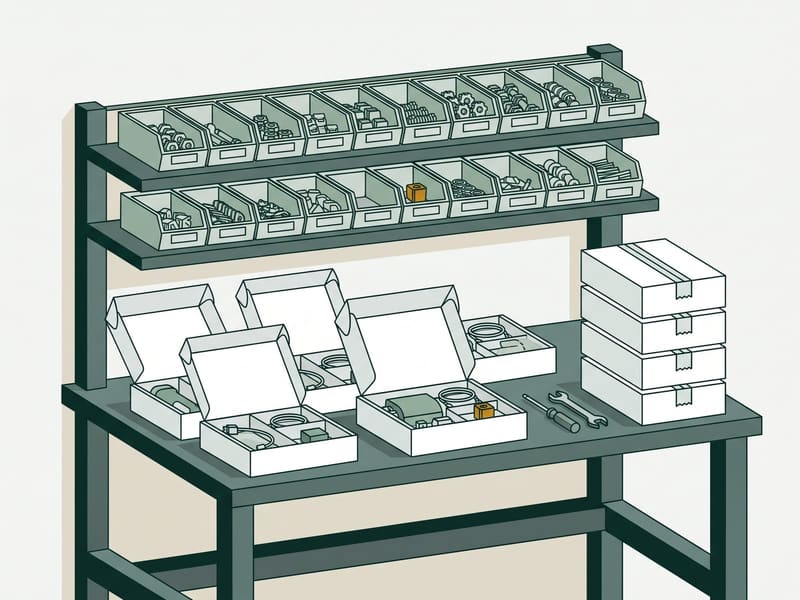
No, Shopify is not a 3PL. It sells the software that runs your store, while a separate logistics company receives your stock, packs each order and hands it to the carrier. Shopify did build a fulfillment network of its own in 2019 and sold most of it in 2023. Below: what the Fulfillment Network app does today, its 8 providers, who bills you, who fixes what, and when a Shopify store needs a 3PL.
Quick summary
- Shopify is commerce software for the storefront, checkout, order records and inventory counts, while the receiving, storing, picking, packing and shipping are done by you or by a 3PL.
- Shopify Fulfillment Network is a free app listing 8 outside logistics providers, and the one you pick stores your stock, ships your orders and bills you for that work.
- The app only serves businesses that fulfill orders from the United States, and every product needs a barcode and a SKU before stock goes out.
- Shopify Support handles the app and the syncing of orders and inventory, while lost, damaged or late shipments go to the 3PL.
- Shopify launched its own fulfillment network in June 2019 and sold the majority of it in June 2023 for a 13% stake in the buyer, booking a $1.3 billion net impairment.
- Shopify Shipping sells discounted carrier labels but stores and packs nothing, so a store using it still needs a packing room of its own or a 3PL.
Shopify sells the store, not the warehouse
Shopify is commerce software. It runs the storefront, checkout, payments, order records and the stock counts in your admin, and it sends each order to whichever location you have set to fulfill it. None of that lifts a box.
A third-party logistics provider does the physical work: it takes in your supplier’s pallets, shelves the units, picks and packs each order and hands the parcel to a carrier. Shopify’s help pages give a store 3 ways to get orders out: pack them yourself, connect an outside fulfillment company through an app, or use a fulfillment service such as Shopify Fulfillment Network. In the last 2, the warehouse belongs to another company.
Shopify says it serves millions of merchants in more than 175 countries, and its order screen behaves the same whether the parcel is taped up on a kitchen table or in a 3PL’s building. Amazon is the useful contrast: with Fulfillment by Amazon, the company that runs the marketplace also runs the buildings your orders ship from, which is why FBA plays the 3PL role and Shopify does not.
Who does what when a 3PL ships Shopify orders
Once a 3PL is connected, Shopify’s setup and support pages split the work 3 ways.
| Task | Shopify | The 3PL | You |
|---|---|---|---|
| Storefront, checkout and the order record | Runs it | Not involved | Set it up |
| Sending each order to a warehouse | Routes it by your rules | Receives it | Write the routing rules |
| Receiving and storing stock | Records the transfer | Counts and shelves it | Create the transfer, ship the cartons |
| Picking, packing and labeling | Not involved | Does it | Supply barcodes, SKUs and packing specs |
| Order and inventory sync errors | Shopify Support fixes them | Refers you to Shopify | Report them |
| Lost, damaged or late shipments | Not involved | Handles them under its contract | File the claim |
| Billing for the warehouse work | Not involved | Sends the invoice | Pay it |
The support and billing rows cause most of the trouble in the first months. Shopify’s support page routes shipping and fulfillment problems with your inventory to the provider, so a ticket about a short receipt or a crushed parcel that lands at Shopify gets sent back to the warehouse, and the clock on the provider’s claim window keeps running.
How Shopify Fulfillment Network works in 2026
Shopify Fulfillment Network is now an app. You install it from the Shopify App Store, choose a provider from its list, open an account with that provider and connect it to your store. From then on you send stock by creating transfers, and you track transfers, orders and inventory in the Shopify admin while the provider stores the goods and picks, packs and ships each order.
Shopify sets 2 conditions of its own. Every product needs a barcode and a SKU, and the app only serves businesses that fulfill orders from the United States: the brand can be based anywhere, but its stock has to be shipped into the US. Each provider then adds its own product guidelines and its own standards for packaging and inbound shipments.
The 8 providers in the app
Shopify lists 8 logistics partners. One connects directly in the admin with no app to install, after some extra setup steps: it is the freight forwarding company that bought most of Shopify’s own logistics business in 2023. The other 7 connect through App Store apps, among them Amazon’s app for Multi-Channel Fulfillment and Buy with Prime, Bigblue and GoBolt, and each app has its own setup steps, requirements and prices.
A place on the list confirms that an app exists and syncs with Shopify. It says nothing about whether the provider accepts your products, has a warehouse near your customers or prices well at your volume. Shopify’s recommendation tool compares the services side by side, and the provider’s sales team answers the rest once you contact it.
What the app costs and who sends the bill
Shopify charges nothing to install the Fulfillment Network app. The provider charges for accepting, storing and fulfilling your inventory on its own rate card, and billing questions go to its support pages, not Shopify’s. Your Shopify plan stays a separate bill.
Here is one month for a skincare brand selling on Shopify that ships 1,200 orders through a provider in the app: 90 SKUs, 1.3 units per order and 6 pallets arriving from its manufacturer. The rates are illustrative ranges, not anyone’s price list.
Shopify’s billing page flags 1 more cost: a 3PL’s fulfillment locations might create physical nexus for sales tax in the states where they sit. A brand that has only ever shipped from its home state can owe filings in a second state from the week its stock arrives there.
Who answers when something breaks
Shopify Support takes problems with the app itself and with the syncing of orders and inventory, plus any case the 3PL has sent back to Shopify. Shipping and fulfillment problems with your stock go to the provider through its own help center, tickets or chat, and Amazon’s support for its fulfillment services asks for valid seller credentials.
Why people ask whether Shopify is a 3PL
For a few years the answer was closer to yes. Between 2019 and 2023 Shopify built a fulfillment network of its own, bought 2 logistics technology companies, then sold most of it in a single deal.
| Date | What Shopify did |
|---|---|
| June 2019 | Introduced Shopify Fulfillment Network |
| September 2019 | Agreed to buy 6 River Systems, maker of the “Chuck” warehouse robots, for about $450 million, 60% in cash and 40% in shares |
| May 2022 | Agreed to buy Deliverr, founded in 2017 and delivering more than 1 million orders a month, for about $2.1 billion, the largest deal in Shopify’s history |
| Third quarter of 2022 | Closed the Deliverr purchase |
| June 6, 2023 | Sold the majority of the logistics businesses to a freight forwarder for a 13% equity stake, on top of shares it already held |
| 2023 | Sold its remaining logistics assets to other buyers |
In the 2022 Deliverr announcement, Shopify promised 2-day and next-day delivery from coast to coast, with its software and robots running both in warehouses Shopify operated and in partner-run ones. A merchant who signed up in those years really did send stock into a Shopify-run network.
Shopify’s annual report for 2023 put the net impairment on the logistics sales at $1.3 billion: $1.4 billion of goodwill, $337 million of intangible assets and $93 million of net assets and transaction costs, less $528 million of stock received. The same report said Shopify expected to keep working with the buyer on logistics for its merchants, and that buyer is the provider wired directly into today’s Fulfillment Network app.
Shopify Shipping sells labels, not fulfillment
Shopify Shipping lets you buy, print and manage discounted labels from supported carriers inside the admin. It sends tracking to customers automatically, books carrier pickups and voids labels you did not use. The discount depends on your Shopify plan, US shippers can add insurance and file claims for lost or damaged parcels, and return labels need a default location in the US.
A label pays a carrier to move a box that someone has already packed. Whether a carrier such as FedEx counts as a 3PL depends on whether you also hire it to store and pack your stock, and a label bought in Shopify never does that.
| Shopify Shipping | Fulfillment Network app | A 3PL connected by its own app | |
|---|---|---|---|
| Who stores and packs | You | The provider you picked | The 3PL |
| Who buys postage | You, at your plan’s discounted rates | The provider | The 3PL |
| Who handles a lost parcel | You, through insurance if you ship from the US | The provider | The 3PL |
| Where it works | Varies by carrier and country | Businesses fulfilling from the US | Wherever the 3PL has warehouses |
When a Shopify store needs a 3PL
A 3PL starts to pay its way when packing is the thing holding the store back:
- Packing has outgrown its room. Orders sit unpacked past the carrier cutoff, or stock is stacked in hallways and a storage unit.
- Customers on the far coast wait. One packing location means ground parcels to the other side of the country take days longer than to nearby states.
- You have added channels. Amazon, wholesale accounts and retail stores each bring their own labels, cartons and prep rules.
- Peak doubles your volume. A November with twice the orders becomes a staffing problem the 3PL already solves for every client in the building.
- Orders need assembly. Bundles, gift sets and inserts are cheaper on a 3PL’s kitting line than at your own table.
Wait when:
- Volume is small or lumpy. A monthly minimum above your quietest month’s fees pays for capacity you are not using.
- Every order is made or finished by hand. Engraving, custom prints and handwritten notes do not survive the move to a pack station.
- You fulfill from outside the US. The Fulfillment Network app is not open to you, so the search starts with local 3PLs and their own apps.
Connecting a 3PL to your Shopify store
The app is the last thing to weigh when comparing 3PLs for a Shopify store: product fit, warehouse locations and the fee card come first, and the connection gets tested with live orders before any stock moves.
Write down who does the fulfilling in the same words your contract uses. “Shopify” in that line is the mistake that sends tickets to the wrong company.
Frequently asked questions
Does the Fulfillment Network app make Shopify a 3PL?
No, it is an app that connects your store to outside logistics providers. The provider you choose runs the warehouse and sets its own product rules and prices. Shopify supplies the connection and the screens where you track transfers, orders and stock.
Does Shopify have its own warehouses?
Not for fulfilling merchant orders today. In June 2023 Shopify sold the majority of the logistics business it had built, and it sold the remaining logistics assets to other buyers the same year. The Fulfillment Network app now sends your stock to an outside provider's buildings.
Who ships my orders if I sell on Shopify?
You decide. You can pack orders yourself, connect a 3PL through its app, or pick a provider inside the Fulfillment Network app. Shopify holds the order record and routes each order to the location you set to fulfill it.
Does the Fulfillment Network app cost anything?
Installing it is free. The provider you pick charges for receiving, storing and fulfilling your inventory on its own rate card, and your Shopify plan is billed separately as before.
Can I use Shopify Fulfillment Network outside the US?
Only if your orders ship from the United States. Your business can be based in another country, but the stock has to be sent into the US to a provider's warehouse. A brand fulfilling from Canada or the UK connects a local 3PL through an app or integration instead.
Is Shopify Shipping the same as outsourced fulfillment?
No. Shopify Shipping lets you buy and print discounted labels, book carrier pickups and void labels you did not use. The storing, picking and packing still happen in your own space, and the size of the discount depends on your Shopify plan.
Can a 3PL that is not in the Fulfillment Network app work with my Shopify store?
Yes. Shopify lets stores connect an outside fulfillment company through a third-party app, so a provider does not need a place on the 8-partner list. Run live test orders, including edits and cancellations, before any stock moves.
Does using a 3PL change my sales tax obligations?
It can. Shopify notes that a 3PL's fulfillment locations might create physical nexus in the US states where they sit. List every state your stock will be stored in and check your registration in each before the first transfer.