Learn
What Is a 3PL? How Outsourced Fulfillment Works for Brands
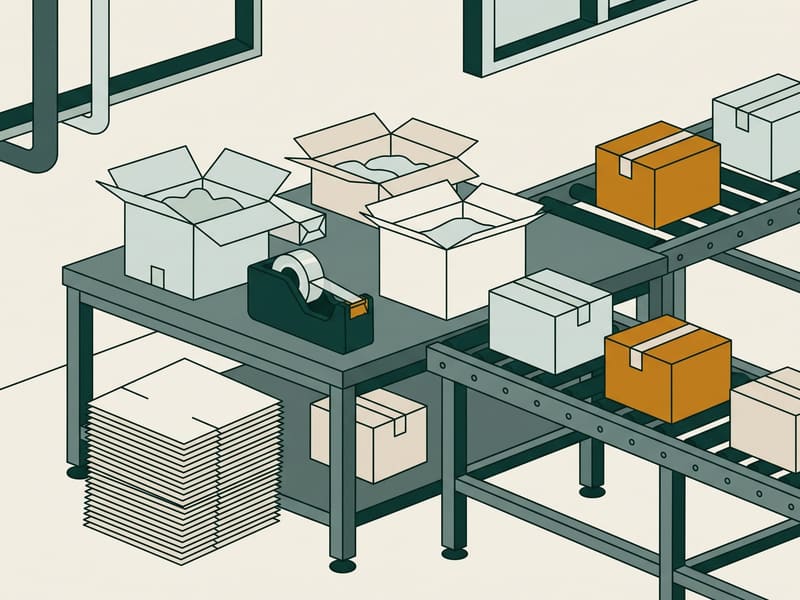
A 3PL (third-party logistics provider) keeps your products in its warehouse and ships your orders for you, for a set of fees. For a growing brand it replaces the spare room, the packing table and the daily carrier drop-off. Below: how a 3PL handles your stock and orders, what it costs at 800 orders a month, how that compares with packing in-house, and how to tell when you are ready.
Quick summary
- A 3PL is a company you hire to receive your inventory, store it, and pick, pack and ship your orders, while the goods and the customer relationship stay yours.
- Forecasting, reordering, product data and replies to customers stay on your desk, while the 3PL runs the warehouse floor and the carrier handoff.
- Our 800-order sample month costs $9,460 to $13,480 including postage, or $11.83 to $16.85 an order, and postage makes up 65 to 68% of it.
- A part-time packer paid the $21.49 median hourly wage BLS reports for warehouse order fillers costs about $2,330 a month before rent, supplies and postage.
- Brands usually start collecting quotes once packing takes 15 or more hours a week, stock outgrows its room, or a retailer asks for labels and advance ship notices.
- The common first-year surprises are a monthly minimum in slow months, slow receiving and an untested integration, and all 3 can be settled in the contract.
What a 3PL is
A third-party logistics provider takes over the physical side of selling products: receiving stock from your suppliers, keeping it on shelves and racks, and turning each order into a labeled parcel on a carrier’s truck.
The Association for Supply Chain Management’s dictionary describes third-party logistics as a partnership between a buyer, a supplier and an outside company that handles product delivery. The buyer and the supplier are the first 2 parties; the logistics company is the third, which is where the name comes from.
The Bureau of Labor Statistics files 3PL warehouses under NAICS 493, warehousing and storage, an industry defined by storing goods it does not sell, with pick and pack, packaging and order fulfillment as common extra services. The industry had 1,837,400 jobs in August 2026, a preliminary figure. For a brand, that definition has a practical meaning: a 3PL never buys your stock, so you keep title to every unit, and the 3PL earns only on space and handling.
By Armstrong & Associates’ count, US 3PL and contract logistics providers took in $323.4 billion in 2025, 5.0% more than the year before. The field runs from single-building operators serving one region up to national 3PL networks with warehouses on both coasts and in between, and which end suits you depends mostly on where your customers are and how many orders you ship.
How a 3PL handles your stock and orders
- Connect your store. The 3PL’s warehouse management system (WMS) links to your store, marketplace or ERP, so online orders flow to the warehouse within minutes and stock levels flow back.
- Send inventory with an advance ship notice. Your supplier’s cartons arrive with an ASN listing each SKU and quantity, and the 3PL counts against it and reports any shortfall.
- Stock goes on shelves by speed. Fast sellers are placed closest to the pack stations and slow ones higher up or further back, each in a scanned location.
- Orders are picked and packed. A picker pulls the items, and a packer scans each one against the order, adds your inserts and seals the box.
- The carrier takes it away. The WMS rate-shops for the lowest-cost carrier service that still hits your delivery promise, and the tracking number flows back to your store as the parcel leaves.
- Returns come back in. Returned parcels are opened, graded and restocked or set aside under the rules you gave.
For an online brand, this work usually happens in a fulfillment center: shelving sized for single units, pack stations near the dock, and carrier pickups at least once a day.
Steps 1 and 2 decide how the first month goes. An integration nobody tested with live orders, or cartons that turn up with no ASN, turn the opening weeks into manual work, and the 3PL charges for that work as labor.
What the 3PL takes on and what stays with you
The 3PL takes on:
- Receiving and counting inbound stock
- Storage, location tracking and cycle counts
- Picking, packing and labeling
- Choosing carrier services and booking pickups
- Processing returns
You keep:
- Buying and forecasting. The 3PL reports stock levels; it does not reorder.
- Product data. Barcodes, weights, dimensions and packing specs have to be right before the first shipment.
- Customer service. Customers still email you; the 3PL answers your tickets, not theirs.
- Inventory risk. The 3PL’s liability for lost or damaged stock is capped by contract, so your own insurance covers the rest.
- Channel rules. Retailer routing guides and marketplace prep standards are yours to pass on.
Most first-quarter disputes come from the second list. A 3PL that runs out of your best seller has usually done nothing wrong: nobody asked it to watch reorder points, and reordering was never its job.
What a 3PL costs at 800 orders a month
Every 3PL prices from a rate card with separate lines. Here is one month for a pet treats brand shipping 800 orders across 120 SKUs, with 1.4 items per order and 4 pallets a month arriving from its co-packer. The rates are example ranges, not a quote.
The box leaves out charges that vary by provider: onboarding fees, monthly minimums and surcharges on stock older than a set age. Of those, the minimum does the most damage to a growing brand, because it bites in the quiet months.
3PL or in-house: comparing the costs
BLS reports a median wage of $21.49 an hour in 2025 for stock clerks and order fillers in warehousing. A part-time packer at 25 hours a week costs about $2,330 a month at that rate, before payroll taxes.
| Cost | Packing in-house | Using a 3PL |
|---|---|---|
| Packing labor | Your payroll, or your own evenings | Inside the pick and pack fee |
| Space | A lease or storage unit, paid full or empty | Per pallet or bin, monthly |
| Equipment and software | Shelving, scale, label printer, shipping software | Included in the rates |
| Postage | Your own carrier rates | The 3PL’s pooled rates, sometimes marked up |
| Peak season | Overtime and temps you hire and train | The 3PL’s staffing problem |
| Mistakes | Caught at your own packing table | Reported back as a ticket |
At 800 orders a month the handling costs land close together: roughly $2,330 of wages plus rent and supplies in-house, against $3,060 to $4,680 of 3PL fees before postage. The gap opens in 2 places. The 3PL buys postage on the volume of every client in the building, and a December with double the orders is its hiring problem rather than yours.
Types of 3PL
ASCM’s dictionary lists 4 types of 3PL, and a growing brand usually deals with the first or the third:
- Warehouse-based: storage and order fulfillment in its own buildings. Many also rent storage by the pallet to brands that pack their own parcels.
- Transportation-based: trucking, brokerage and managed freight. Some run cross-docking hubs that move freight from inbound to outbound trailers without storing it.
- Full-service: one account covering storage, freight and value-added services such as kitting. The larger ones also sign contract logistics deals to run a dedicated building for one client over several years.
- Financial and information-based: auditing and paying freight bills, or selling shipment visibility software, with no warehouse floor.
Two more splits matter when you compare providers. Asset-based 3PLs own or lease their buildings and trucks, while non-asset ones arrange capacity from others and can change it quickly. And every building is tuned to an order profile: a floor laid out for thousands of single-item mailers struggles with a 12-pallet retail order, and the reverse is just as true.
One rung up, a 4PL runs no warehouse at all: it hires and coordinates 3PLs and carriers for brands that already manage several of them.
Signs your brand is ready for a 3PL
When to wait:
- The unboxing is handmade. Hand-wrapped, engraved or made-to-order items lose something at a 3PL pack station.
- Volume is tiny or lumpy. A monthly minimum above your quietest month’s fees means paying for idle capacity.
- Goods are bulky. Furniture, bikes and anything over carrier size limits needs a 3PL set up for freight, not a parcel operation.
How to find your first 3PL
Once you are shortlisting 3PLs, the request you send decides whether the quotes can be compared at all. A vague email gets a generic price sheet back; a profile of your orders gets a rate card priced against a real month.
Before signing, settle the 3 things behind most first-year surprises: a minimum that fits your slowest month, a receiving time in business days that still holds in November, and an integration tested with live orders before any stock ships.
Frequently asked questions
How does a 3PL make its money?
A 3PL charges for each piece of work it does: receiving, storage, picking, packing, materials and extras such as kitting. Many also resell postage above the carrier rate they negotiated for all their clients combined. Setup fees and monthly minimums round out the model for small accounts.
What do 1PL, 2PL, 3PL, 4PL and 5PL mean?
They describe how much of the logistics work a company hands out. A 1PL moves its own goods, a 2PL is a carrier hired to move them, and a 3PL runs outsourced storage, fulfillment and transport. A 4PL manages several 3PLs and carriers for the shipper, and 5PL loosely describes coordinators that pool many shippers' freight, mostly through software.
Does Amazon count as a 3PL?
For sellers using Fulfillment by Amazon, it plays the 3PL role: Amazon says sellers send stock to its fulfillment centers, where Amazon ships each order and takes on the customer service and returns for it. Amazon Warehousing and Distribution also holds bulk stock and supplies other sales channels. Its fees and rules are built around the Amazon store, so brands with large sales elsewhere often add a separate 3PL.
What kinds of companies are 3PLs?
3PLs range from single-warehouse operators serving local brands to national networks with dozens of buildings. Freight brokers with warehouses, the logistics divisions of carriers, contract logistics firms running dedicated sites, and ecommerce fulfillment specialists all count. The right kind depends on whether you ship parcels, cases to retailers or full pallets.
How many orders a month do I need before using a 3PL?
There is no fixed number, but in our view the question gets serious at a few hundred orders a month or once packing takes 15 or more hours a week. Below that, most 3PL minimums cost more than packing yourself. Compare your slowest month's likely fees with the provider's minimum before you decide.
Does a 3PL handle returns?
Most do: returned parcels are received, inspected and restocked or set aside under your rules, usually for a fee per return. You still decide on refunds and exchanges and talk to the customer. Put the grading rules in writing, or opened but unused items end up in the wrong pile.
Is a 3PL cheaper than shipping orders yourself?
Not always at low volume, where your own time looks free on paper and a monthly minimum does not. Past a few hundred orders a month, pooled carrier rates, no lease and no peak-season hiring usually tip the balance toward the 3PL. Our 800-order example comes to $11.83 to $16.85 an order with postage included.