Learn
3PL Warehousing for Growing Brands: Costs, Terms and Types
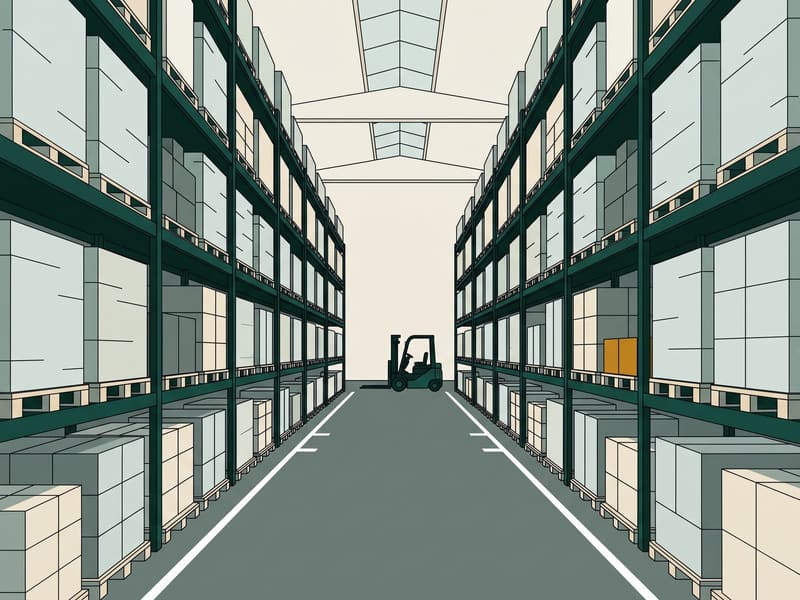
3PL warehousing is storage you rent from a third-party logistics provider, with the staff, racking and software already in place. Your stock arrives at its dock, gets counted and put away, and leaves when you or your customers order it. We follow one container through the building, compare shared and dedicated setups, price a sample month, and cover location, specialist storage and what to check on a site visit.
Quick summary
- A 3PL warehouse holds and ships inventory for client brands without ever owning it, and BLS counted 23,848 private establishments in the warehousing and storage industry in early 2026.
- You can share a building on a rate card, reserve a dedicated zone inside one, or contract a whole building, a deal Armstrong & Associates says typically runs 1 to 3 years.
- Our 90-pallet beverage example costs $4,776 to $8,268 a month before freight, and 67% of it is handling rather than storage.
- The billing rule matters as much as the rate: in our example, counting pallets on the month's peak instead of the daily average adds 22% to the storage line.
- Location sets the freight bill, so importers weigh distance from the port while brands shipping nationwide look at central hubs with short ground transit to both coasts.
- A site visit shows more than a rate card: labeled locations, clear aisles, scanned moves, posted count results and a dock that is not backed up.
What 3PL warehousing means
3PL warehousing is renting storage together with the people and systems that run it. A logistics provider receives your stock, keeps it in racked and tracked locations, and ships it on your instructions: whole pallets to a retailer, cases to a distributor, or single units for online orders.
It is the simplest form of working with a 3PL. The provider supplies the building, the crew, the forklifts and the warehouse management system (WMS); you keep title to every unit and pay for the space and handling you use.
The Bureau of Labor Statistics draws the line around the warehousing and storage industry with one rule: its businesses store goods they do not sell, with extras such as labeling, breaking bulk, light assembly and pick and pack layered on. There were 23,848 private establishments in the industry in the first 3 months of 2026, a preliminary count, and 4.8 recordable injuries and illnesses per 100 full-time workers in 2024, a benchmark to hold any provider’s own safety record against.
Contract warehousing is a large slice of the logistics market. Armstrong & Associates tracks contract warehousing and distribution center management as its own segment, worth $72.7 billion in 2025, out of $323.4 billion for US 3PL and contract logistics as a whole.
How your stock moves through a 3PL warehouse
Follow one 40-foot container of camping gear from the port to the customer:
- Book the dock. The trucker delivering the container books an appointment. A container that turns up without one can wait in the yard and run up charges.
- Unload. A floor-loaded container is unloaded by hand, carton by carton, and stacked onto pallets. A palletized one comes off by forklift in a fraction of the time, and the invoice shows the difference.
- Count against the ASN. Receivers scan each carton against the advance ship notice and record shortages, overages and damage, with photos.
- Label and put away. Each pallet gets a license plate label and a rack location in the WMS. Cartons without a scannable barcode are held aside for relabeling instead of being forced into stock.
- Store and count. The pallet sits in reserve racking, and cycle counts check a slice of locations every week so the building never has to stop for a full count.
- Replenish. When the shelves for online orders run low, a forklift brings a pallet down. That forward area is run as a fulfillment center, with single units slotted for fast picking.
- Ship. Retail orders leave as full pallets or mixed cases built to the retailer’s label and pallet rules; online orders leave as parcels.
- Take returns. Returned units come back through their own receiving step and go back to stock or to a hold area.
Every step is a billing event, and knowing which step a line belongs to makes a rate card readable. Unloading is usually charged per container, counting per carton or pallet, and outbound per pallet, case or order.
Shared, dedicated or in between
The first decision is how much of the building is yours.
| Shared space | Dedicated zone | Dedicated building | |
|---|---|---|---|
| What you get | Pallet positions among other clients’ stock | Your own racked section in a shared building | A whole building, or most of one |
| Term | Month to month or 1 year | Often 1 to 3 years | 1 to 3 years is typical; some run 10 or more |
| Pricing | Standard rate card | Rate card plus a fixed charge for the reserved space | Negotiated: space, labor and a management fee |
| Crew | Shared across clients | Shared, often with a named lead for your account | A team hired and trained for you |
| Setup | The 3PL’s standard racking and WMS | Your racking layout inside their systems | Racking, automation and systems built to your spec |
| Suits | Seasonal or fast-changing volume | Steady volume that needs its own space | Volume that keeps a building busy all year |
Dedicated contracts are the long ones. Armstrong & Associates reports terms of 1 to 3 years as typical for contract warehousing, and 10 or more for some deals, while short-term shared space sits outside its contract warehousing figures altogether.
Specialist 3PL warehouses
Some products need a building set up for them. What to ask for depends on the type:
- Temperature-controlled: chilled, frozen or climate-controlled zones for food, supplements, cosmetics and pharma. Ask for temperature logs and how fast someone responds to an alarm at night.
- Food-grade: pest control, lot tracking and first-expired-first-out picking for anything people eat. Ask for the latest third-party audit and a mock recall result.
- Bonded: imported goods held under a customs bond, with duty unpaid until they leave for the US market. Some 3PL buildings also operate inside a foreign-trade zone, where imports can be stored and handled with duty deferred until they enter US commerce. Ask for the bond or zone paperwork.
- Hazmat: aerosols, lithium batteries, flammables and chemicals, stored under permits with segregation rules. Ask for the permits in writing, per product class.
- High-value: caged or vaulted areas with camera coverage and restricted access for electronics, jewelry and luxury goods.
- Bulky and heavy: floor stacking, oversized doors and equipment for furniture, fitness gear and appliances.
How 3PL warehouses charge
Storage is sold in units: a pallet position (a standard pallet up to a set height), a shelf or bin location for loose cartons, a cubic foot for mixed goods, or square feet for dedicated space. Handling is sold per container, pallet, carton, case or order.
The rule that counts your storage matters as much as the rate. Here is one month for a brand whose stock dips to 70 pallets and peaks at 110, averaging 90:
| Billing rule | How it counts | Positions billed |
|---|---|---|
| Snapshot | Pallets on hand on 1 set day, often the 1st | Anything from 70 to 110 |
| Daily average | The mean of each day’s count | About 90 |
| Monthly peak | The highest count in the month | 110 |
| Anniversary | A full month per pallet from the day it was received, renewed every 30 days | Depends on receiving dates |
On the same stock, the peak rule bills 110 positions and the daily average about 90: 22% more before anyone argues about the rate.
Now the whole bill. The example is a canned beverage brand holding 90 pallets, receiving 6 palletized truckloads a month from its co-packer, and shipping full pallets and mixed cases to distributors and grocery chains. Every rate below is an example range rather than a quote.
Handling is labor. BLS puts 2025 median pay in warehousing and storage at $22.06 an hour for hand laborers and material movers and $23.16 for forklift operators, and average hourly earnings across the industry reached $26.74 in July 2026 (preliminary). A per-pallet or per-case rate is mostly those wages, plus supervision, equipment and margin.
Rate cards also carry charges that appear only when something goes wrong: relabeling cartons, restacking pallets that arrive unstable, hand-unloading a container that was supposed to be palletized, and holding shipments a customer refused. Ask for that page of the rate card before you sign, not after the first invoice.
The clause that matters most on a busy dock is the one on receiving, because stock that has not been received cannot be sold.
Where the warehouse should be
Location sets your freight bill more than any line on a rate card. Start from where goods come in and where they go out:
- Imports by ocean, customers everywhere: a building near the port of entry, then a second one inland once volume supports it.
- Domestic production, online orders nationwide: a central location, so ground parcels reach both coasts in fewer transit days.
- Retail and distributor orders: close to your customers’ own distribution centers, where delivery appointments are tight.
Central hubs earn their place through the roads around them. Interstates 65, 69, 70 and 74 all meet at Indianapolis, and warehouses around Indianapolis compete with coastal buildings on that reach: most Midwest cities are within a day’s truck drive. Rent is often lower inland than beside a major port, while freight rises with every mile from the dock, so price both before you choose.
Growth often ends with stock in several buildings. Once 3 or more of them are run by different 3PLs, some brands hand the coordination to a fourth-party manager rather than running every contract themselves.
What goes wrong in a 3PL warehouse
Most problems start at receiving or in the counts, and each has a fix you can set up on day 1:
- Stock put away under the wrong SKU. It surfaces weeks later as mis-shipped orders. Require a scannable SKU label on every carton from your supplier, and have the 3PL hold unlabeled cartons rather than guess.
- Counts that drift. The 3PL’s numbers and your own slide apart a few units at a time. Reconcile the two every month, and ask for a recount of any SKU off by more than 1%.
- Slow movers that never leave. A pallet of a discontinued flavor costs the same to store as a best seller. Every quarter, list stock older than 6 months and choose for each SKU: discount it, send it to a liquidator, or move it to cheaper bulk storage.
- Peak congestion. Every client’s freight arrives in the same few weeks, so the dock becomes the bottleneck unless your inbound is booked early and the contract sets a receiving time.
How to check a 3PL warehouse before you sign
A rate card tells you what a warehouse charges. A walk through the building tells you how it runs.
Then ask for 3 numbers in writing: last quarter’s inventory accuracy, receiving time in business days at peak, and the storage billing rule. A provider that cannot produce all 3 before you sign will not produce them after.
Treat the move itself as a test. Send a partial first shipment of your top 20 SKUs, check the received counts against your ASN line by line, and run a week of real orders off it before sending everything else. Any labeling or integration problem then costs you a few cartons of rework instead of a full container.
Frequently asked questions
What is a 3PL warehouse?
It is a building where a logistics company keeps other businesses' inventory and sends it out when they say so. Staff, racking and warehouse software come with the space, and each client is billed for its own storage and handling. Many 3PL warehouses also pick and pack online orders.
What does 3PL warehousing cost per pallet?
Pallet storage is usually quoted per position per month, and in our example it runs $16 to $26, but rates depend on the region, the product and the billing rule. Handling is charged separately per pallet, case or order, and it often costs more than the storage itself. Price a full month of your own activity rather than comparing pallet rates alone.
Can Amazon act as my 3PL warehouse?
For inventory sold on Amazon, partly. Fulfillment by Amazon stores and ships units sold on Amazon, charging storage monthly by average cubic feet plus an extra monthly charge once items pass 181 days in storage, and Amazon Warehousing and Distribution holds bulk stock that can also feed other channels. Brands with large wholesale or DTC volume usually keep a separate 3PL warehouse too.
What are the downsides of a 3PL warehouse?
You no longer run the floor yourself, and at peak your freight queues with other clients' for dock time and labor. Billing rules and accessorial charges can push the invoice well past the headline rate. Leaving later costs freight, a second round of receiving fees and days when stock is stuck in transit.
Is a 3PL warehouse the same as a fulfillment center?
Not quite. A 3PL warehouse is built around storing and moving pallets and cases, while a fulfillment center is built around shipping single orders to consumers fast. Many 3PL buildings run both, with bulk racking feeding a pick area for online orders.
How long do 3PL warehouse contracts last?
Shared space usually runs on a short agreement, from month to month up to a year, at rate-card prices. Armstrong & Associates reports that dedicated contract warehousing deals most often last 1 to 3 years, with some reaching 10 years or more. Longer terms usually buy more investment in racking or automation for your operation.
Do I need my own insurance for stock in a 3PL warehouse?
Yes, in almost every case. The 3PL's liability for loss or damage is limited by the warehouse agreement, often to a set amount per pound or per unit, which is usually far below what the stock is worth. Insure the difference, and check that your policy covers goods held at a third party's location.