Learn
What Is a Fulfillment Center? Zones, Costs and Amazon FBA
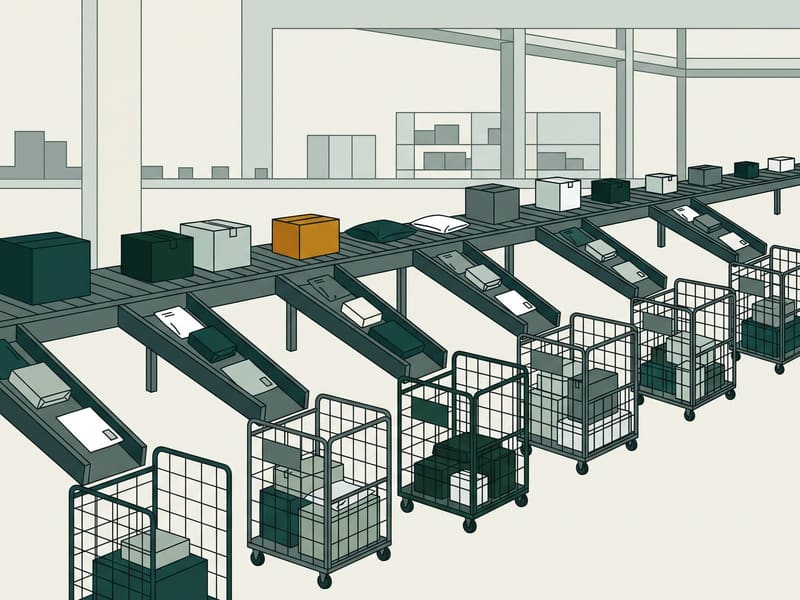
A fulfillment center is where stored stock becomes shipped orders. Inventory arrives by the pallet, sits on shelves for a few days or weeks, then goes out as single parcels bound for customers' doors. We walk through the zones of a typical building, the numbers to judge one by, how it differs from a warehouse, where Amazon's network fits, and when a second location starts to pay for itself.
Quick summary
- A fulfillment center receives a seller's inventory, holds it briefly, and picks, packs and ships each order, and most are run by 3PLs serving many brands at once.
- The building works in 6 zones: receiving, reserve storage, a forward pick area, pack stations, shipping and returns.
- Hold any fulfillment center to 5 numbers: dock-to-stock time, same-day ship rate, order accuracy, inventory accuracy and returns turnaround.
- Amazon's fulfillment centers serve FBA sellers, with storage billed monthly by average cubic feet and an added charge on stock kept past 181 days.
- In our 3,000-order example, a second site adds $1,640 to $3,120 a month in fees and saves $1,800 to $3,600 in postage, so it can land either way.
What a fulfillment center does
A fulfillment center is a building organized around one job: turning the inventory inside it into orders on their way to customers. Stock comes in bulk, is broken down onto shelves, and goes out one parcel at a time, most of it the same day the order lands.
In federal statistics these buildings count as warehousing. BLS classes the warehousing and storage industry (NAICS 493) as businesses holding goods they do not sell, and names order entry and fulfillment, packaging, and pick and pack among the services they add. That describes the most common operator: third-party logistics companies running one building for dozens of brands, which share the staff, the equipment and the daily carrier pickups and pay per order.
The other 2 kinds of operator are marketplaces, with Amazon’s network the best known, and brands large enough to lease and staff a building for their own orders.
The zones inside a fulfillment center
Walk into almost any fulfillment center and you pass through the same 6 zones, in the order your stock does:
| Zone | What happens there | What goes wrong for your brand |
|---|---|---|
| Receiving dock | Pallets and cartons are counted against the advance ship notice and checked for damage | Freight that arrives without an ASN waits, and your sales wait with it |
| Reserve storage | Full cartons and pallets sit in high racking | Units here are in the building but cannot be picked yet |
| Forward pick area | Single units on shelves or in bins, fast sellers nearest the pack line | Too little stock forward means orders wait for a replenishment run |
| Pack stations | Items are scanned against the order, boxed, cushioned and given inserts | An oversized box raises postage, because carriers bill on dimensional weight |
| Shipping and sortation | Labels print and parcels are sorted by carrier and service onto trailers | A parcel that misses the last trailer ships a day late |
| Returns area | Parcels are opened, graded, restocked or set aside | A backlog here hides stock you could be selling |
Where each SKU sits is called slotting, and it decides how far pickers walk. Low-volume buildings pick one order at a time; busy ones send pickers out with batches of orders that share SKUs, or release orders in timed waves matched to carrier pickups.
Most fulfillment centers also sell work beyond pick and pack: assembling gift sets and kits, retail and compliance labeling, custom boxes and printed inserts, and inspecting goods on arrival. It is priced per unit or by the hour, and it runs only as well as the written instructions you give.
How fast a fulfillment center ships
Speed comes down to 2 times: the order cutoff and the last carrier pickup. An order that reaches the warehouse management system before the cutoff ships that day; one that arrives after it ships on the next business day. The cutoff sits earlier than the last pickup by however long the floor needs to pick, pack and stage an order for the trailer.
Weekends are the other gap. Many buildings run Monday to Friday, so an order placed on Friday evening leaves on Monday unless your contract pays for weekend shifts. Whatever the building’s hours, the promise on your website has to match them, because the customer holds you to the promise, not the 3PL.
What a fulfillment center charges
A fulfillment center bills each piece of work as its own line:
- Receiving: per pallet, carton or hour when stock arrives.
- Storage: per pallet, shelf or bin each month, sometimes by the cubic foot.
- Pick and pack: a base fee per order, then a lower add-on for every unit past the first.
- Packaging: per box or mailer, unless you supply your own.
- Postage: per parcel, at the 3PL’s carrier rates or on your own account.
- Extras: kitting, labeling, returns and special projects, per unit or per hour.
Postage tends to be the largest line on a parcel brand’s invoice, so the carrier rates a fulfillment center passes on matter more than a few cents either way on the pick fee. Ask every provider to price the same 3 months of your orders, with postage included, before you compare them.
5 numbers to judge a fulfillment center by
A fulfillment center is only as good as what it measures and reports to you. These are the 5 numbers worth writing into the contract, with the targets we would ask for:
| Metric | What it measures | The target we would ask for |
|---|---|---|
| Dock-to-stock time | How long a delivery waits at the dock before its units go live for sale | 24 to 48 hours, with any peak exception in writing |
| Same-day ship rate | Share of orders received before the cutoff that ship that day | 99% or better |
| Order accuracy | Orders shipped with no wrong, missing or extra item, as a share of all orders | 99.5% or better |
| Inventory accuracy | How closely system counts match physical counts at cycle count | 99% or better, by unit |
| Returns turnaround | Days from a return arriving to its units being restocked or set aside | 3 to 5 business days |
These are our contract asks, not an industry standard, and a provider may offer different numbers. What matters is that every one is defined, measured monthly and tied to a remedy.
Fulfillment center, warehouse or distribution center?
| Fulfillment center | Warehouse | Distribution center | |
|---|---|---|---|
| Optimized for | Speed per order | Cost per unit stored | Speed per truckload |
| A typical shipment | A 2-item parcel to a home | A pallet released when you call for it | 20 pallets to a chain’s stores |
| Ships to | Consumers | Your other sites, or bulk buyers | Stores and business customers |
| How long stock stays | Days to weeks | Months, sometimes years | Hours to days |
Many 3PL buildings combine the first 2 columns, keeping bulk pallet storage in the back racking and a fulfillment floor near the dock, with the forward pick area topped up from reserve. For a brand, the combination means one inventory pool can feed both web orders and wholesale.
Amazon fulfillment centers and FBA
Amazon runs the best-known fulfillment network, which it puts at hundreds of fulfillment centers worldwide. Under Fulfillment by Amazon (FBA), sellers send stock into those buildings, and Amazon delivers each Amazon order and handles the customer service and returns that follow.
Amazon’s own FBA page sets out how it charges: fulfillment fees follow each product’s price, weight and dimensions; monthly storage follows the average daily cubic feet your stock takes up; and an aged-inventory charge applies every month to units kept more than 181 days. Amazon Warehousing and Distribution, its bulk tier, can supply both Amazon and non-Amazon sales channels.
For a brand selling on its own site and on Amazon, a common setup splits the work: Amazon’s network ships the marketplace orders and a 3PL fulfillment center ships the rest, with bulk stock feeding FBA in regular top-ups.
One fulfillment center or two
A second fulfillment center puts stock closer to more customers, so parcels travel fewer zones and arrive sooner. It also splits your inventory, which adds freight, receiving and storage. For a brand shipping 3,000 orders a month from one coast, adding a site on the other looks like this:
The faster delivery does not show up in the box, and for some brands it decides the question on its own. Air access is the other location factor. Memphis is home to FedEx’s main air hub, so brands selling overnight delivery weigh fulfillment centers around Memphis against coastal sites on air reach as well as ground reach.
Past 2 or 3 sites with different operators, the planning starts to need its own owner, and some brands bring in a 4PL to plan stock across them.
Is a fulfillment center right for your brand?
Good fit:
- Daily orders. Parcels go out every day and someone on your team spends hours packing them.
- Customers expect 2 to 5 day delivery. A building with daily pickups and pooled carrier rates can meet that promise more cheaply than a back room.
- More than one channel. Your store, a marketplace and wholesale all draw on one pool of stock.
- Seasonal peaks. A December at 3 times your average is the operator’s staffing problem instead of yours.
Not yet:
- Mostly pallets to retailers. A warehouse or distribution center suits that order profile better.
- A few orders a week. Setup fees and monthly minimums will outweigh the time saved.
At the other end, brands shipping enough to keep a building busy on their own sometimes move from a shared fulfillment center to a dedicated contract logistics site run for them alone under a multi-year agreement.
The first shipment into a new fulfillment center needs the most care, because nothing about your products is in its system yet.
Frequently asked questions
How is a fulfillment center different from a warehouse?
A fulfillment center is organized around shipping individual orders fast, while a warehouse is organized around holding stock cheaply until it is needed. Stock in a fulfillment center turns over in days or weeks, and carriers collect every day. A lot of 3PL buildings do both jobs in different parts of the floor.
What are some examples of fulfillment centers?
The common types are a 3PL's shared building serving many brands, a marketplace network such as Amazon's serving its sellers, and a brand's own site shipping only its own orders. Grocers and big-box retailers also run small urban sites for same-day orders. What they share is the job of turning stock into shipped orders.
What does an Amazon fulfillment center do?
It stores inventory for Amazon orders, including stock that sellers send in through Fulfillment by Amazon, and ships those orders to customers. For FBA sellers, Amazon also takes on customer service and returns on Amazon orders. Sellers pay a fulfillment fee per unit and monthly storage based on cubic feet.
Can you buy things at an Amazon fulfillment center?
No. Fulfillment centers are closed industrial sites with no shop, counter or customer pickup. Everything inside leaves by carrier to fill orders placed online.
What is an order cutoff time?
It is the latest time an order can reach the fulfillment center and still ship that day. Orders that arrive after it ship the next business day. Match the cutoff to the shipping promise on your website, or customers will be promised one thing and get another.
Who owns the stock inside a fulfillment center?
The brand does. A 3PL fulfillment center holds your goods without buying them, and the contract caps what it pays if goods are lost or damaged, usually well below retail value. Keep your own insurance and check your counts against the 3PL's every month.
Is a fulfillment center the same thing as a 3PL?
No. The fulfillment center is a building and the 3PL is a company, and one 3PL may run several fulfillment centers alongside freight and bulk storage services. Brands and marketplaces also run fulfillment centers without being 3PLs.